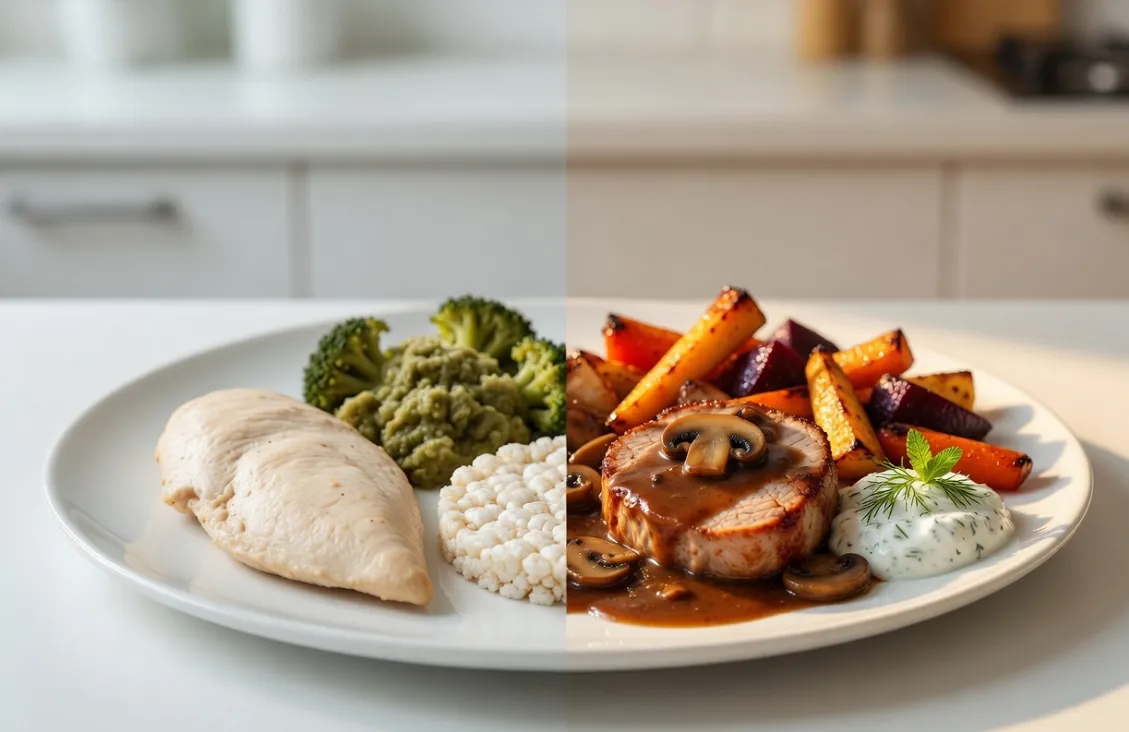
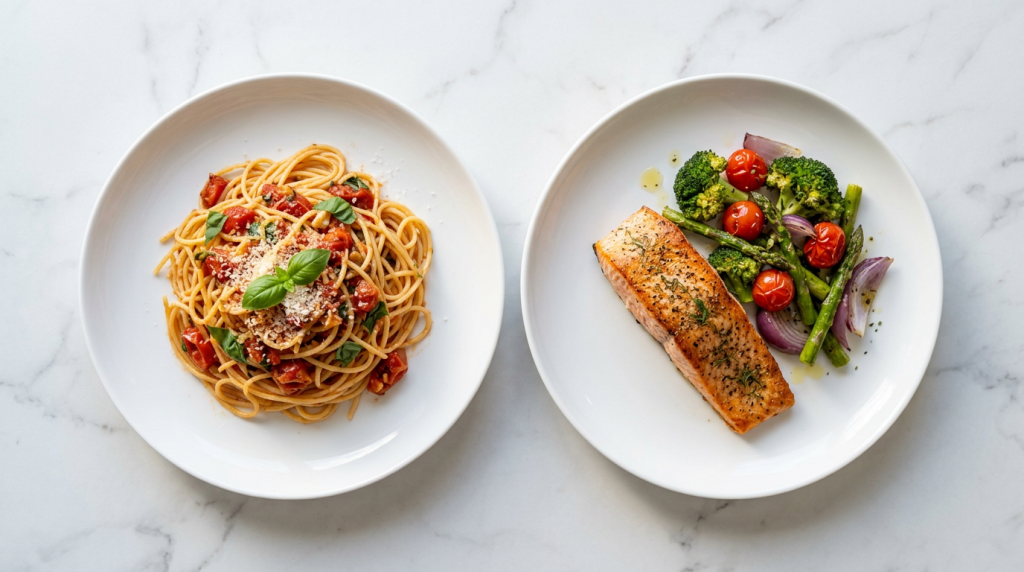
You were handed a list. Maybe from your doctor, maybe from a Facebook group. The list said “safe foods for GLP-1.” Chicken breast. Steamed broccoli. Egg whites. Plain rice cakes.
You have been eating these things for weeks. You are losing weight. You are also quietly miserable. Every meal feels like a chore. You eat because you have to, not because you want to.
And somewhere underneath the gratitude for finally losing weight, a darker thought is forming.
Is this just what life looks like now?
Here is what no one told you: the way you are eating right now is actively working against your long-term success.
Diet food. Let’s define it.
Diet food is food you eat because you think you should, not because you want to. Low-calorie packaged products. Bland proteins with no fat or seasoning. Salads that would make a rabbit weep. The connecting thread is not the calorie count. It is the joylessness. You are tolerating the food rather than eating it.
That distinction matters more than it sounds.
The window you are wasting
The medication suppresses your appetite. You feel full faster. You think about food less often. For most people, this feels like the solution to a lifelong struggle.
But here is the problem with that framing. You are not learning anything. You are not building new habits. You are enduring. You eat the chicken. You eat the broccoli. You wait until you reach your goal weight or the medication stops.
Then what?
You go back to the foods you actually want. The ones you stopped eating because they were not on the list. The weight comes back. The medication gave you a genuine opportunity, and you spent it eating food you hated while waiting for the whole thing to be over.
The window does not stay open. What you do with it determines whether the change sticks.
The muscle problem
This is where it stops being merely joyless and starts doing damage. Muscle doesn’t just sit there while you lose weight. It needs protein to hold on. Without it, your body takes what it needs from the muscle itself. Less muscle means a slower metabolism. A slower metabolism means the weight comes back harder once the medication stops. While the medication helps you lose the weight, it silently chips away at your ability to keep it off. The only thing that protects you is eating enough protein to hold on to your muscle while the weight comes down. The full mechanism is explained here.
The wrong lesson
There is another cost to eating food you hate, and it compounds.
Every time you force down another dry piece of chicken, your brain files it away. Healthy eating is punishment. Healthy food is what you eat when you are trying to lose weight, not what you eat when you want to live your life. Those associations outlast the medication. They outlast the weight loss. And they make permanent habits almost impossible to build, because permanent habits require food you actually want to eat.
Almost no one maintains a diet they hate. The people who seem to are exceptions, and they are usually the ones making videos about how you can do it too.
You might. For a while.
Willpower runs out. Enjoyment does not.
What to do instead
Recognize the window for what it is. You have a period of reduced appetite that will not last forever. Use it to experiment. Try new proteins. Learn what you actually like when hunger is not in charge. This is not a sentence to bland meals. It is a chance to build a different relationship with food.
Make protein the priority. Calories are largely handled by the medication. Your job is to make sure every meal contains a meaningful source of protein. That is how you protect your muscle. That is how you stay full in a useful way. That is how you come off the medication in better shape than when you started. A simple breakfast bake that serves well as a meal prep for several days is a great place to start.
Eat food you actually want to eat. If you would not serve it to a friend for dinner, do not eat it yourself. Season your food. Use sauce. Cook the vegetables until they taste good. The medication already handled the appetite problem. You do not need to also solve it with joylessness. Ground chicken or turkey doesn’t have to be reminiscent of cardboard, there are simple recipes like a one pan turkey skillet that will make you rethink what you thought you knew.
The people who succeed long term on GLP-1 are not the ones who ate the smallest portions or the blandest meals. They are the ones who used the window to learn how to feed themselves well. They protected their muscle. They built habits that outlasted the medication. They ate food they actually enjoyed.
Are you tired of chicken yet? Good. That tired feeling is telling you something. Put down the list. Cook something you actually want to eat. Your future self will thank you.
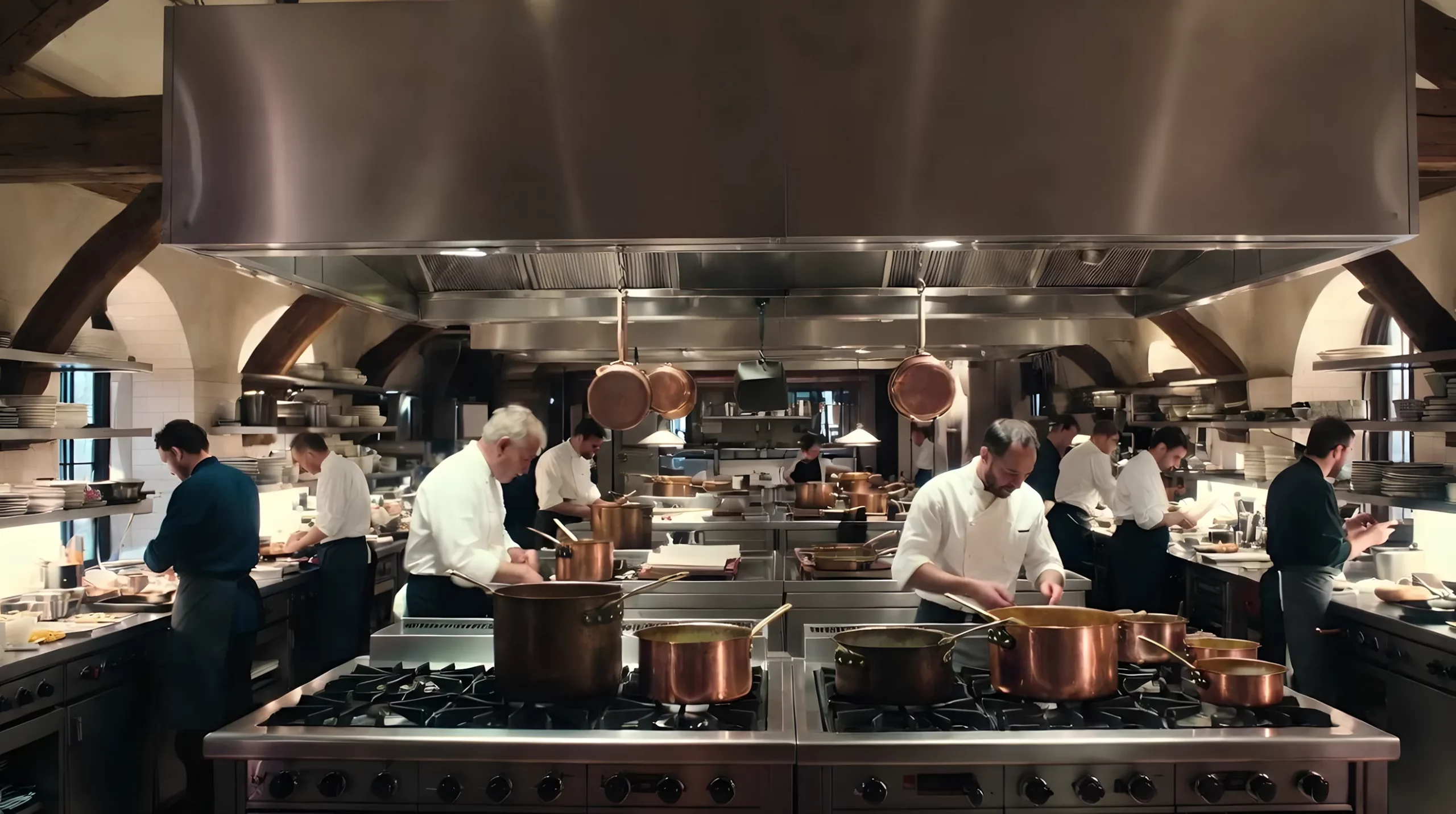
Sous vide, the name alone brings thoughts of hectic French kitchens with screaming chefs and cowering line cooks. Something mysterious using expensive machines and difficult techniques.
Reality, it is a bag in a pot of water with a small, uncomplicated machine that does most of the work without you having to watch it.
What is Sous Vide?
At its core, sous vide, French for “under vacuum,” is a method of precision temperature control. Instead of applying high, fluctuating heat to the outside of food from a pan, oven, or grill, you seal the food in a bag and submerge it in a water bath held at a single, exact temperature.
The goal is not to cook in the traditional aggressive sense but to gently bring the food to the exact doneness you want from edge to edge. A steak cooked to 129 degrees Fahrenheit will be medium rare from the crust to the center with no grey band. An egg cooked to 147 degrees will have a tender white and a yolk that is custard like, never chalky or runny.
A Game-Changer for GLP-1 Users
For those on GLP-1 medications ,two of the most common side effects, aversion to food smells and a general lack of appetite, make the act of cooking feel counterproductive. Sous vide eliminates the two biggest barriers. First, there is no scent. Because the food is sealed in a plastic bag, there is almost no aroma released into the kitchen while it cooks. You do not get the grease spatter smell of frying bacon or the lingering odor of roasting chicken that can trigger nausea. Second, there is no complex cooking. You are not standing over a stove stirring and managing temperatures while your appetite fades. You seal the bag, drop it in the water, and walk away. This lowers the effort required to cook, making it easier to prepare small, protein rich meals even when you feel fatigued or indifferent to food.
The Science of “Set it and Forget it”
Sous vide also changes the rules of doneness by decoupling temperature from time. In traditional cooking, you race against the clock. If you leave a chicken breast on the heat five minutes too long, it becomes dry and stringy. Sous vide eliminates that anxiety. Because the water never exceeds your target temperature, the food cannot get hotter than that. You can cook a pork chop to 140 degrees and leave it in the water for an extra hour without drying it out. Tough cuts like short ribs, brisket, or chuck roast require hours of heat to break down collagen into gelatin. Sous vide allows you to hold these cuts at precise temperatures, often between 155 and 165 degrees, for 24 to 48 hours. You get the texture of a long braised pot roast but with the structural integrity to still be sliced cleanly and zero risk of burning the fond on the bottom of a Dutch oven. One of the greatest benefits is the flexible holding window. If dinner time is uncertain or if you are eating smaller meals on a GLP-1 schedule, you can leave the food in the water bath for an extra hour or two without degrading the quality. When you are ready to eat, you simply pull the bag out, pat it dry, and sear it for a minute, resulting in a meal that tastes freshly cooked, not like a reheated leftover.
Some of the equipment below includes affiliate links. As an Amazon Associate I earn from qualifying purchases. It doesn’t change what I recommend.
Getting Started: The Essential Setup
You do not need a lab setup or expensive restaurant equipment. The barrier to entry is remarkably low. For the bare minimum setup, you need: a sous vide immersion circulator, which clamps onto the side of a pot, heats the water, and circulates it to maintain an exact temperature. Decent entry level models cost between 70 and 100 dollars. The one I use is the Anova Precision Cooker 3.0, which has been reliable across long batch cooks without struggling to hold temperature. There are less expensive options that will work, but the Anova handles high-volume sessions without complaint. You need a large pot, a stockpot or any large cooking pot works fine, sized to accommodate the water depth required by your circulator and allow water to flow freely around the bags. You need Ziploc freezer bags, which are thicker and less likely to puncture than standard bags. You need alligator clips, small binder clips or dedicated sous vide clips, to clip the top of the bag to the side of the pot, keeping the seal above the water line to prevent water from getting in. And you need cling wrap. Laying a sheet of cling wrap over the surface of the water prevents evaporation during long cooks, ensuring your circulator does not run dry overnight.
Upgrades Worth Making
Once you decide you enjoy the method, a few upgrades streamline the process and improve results.
A dedicated tank with a lid, often a polycarbonate food storage container branded as a sous vide tub, is superior to a pot. It is lightweight, clear for visibility, and usually comes with a fitted lid. The EVERIE Sous Vide Container is a solid option. It comes with a lid that has a cutout for the circulator, which virtually eliminates evaporation and makes the unit far more energy efficient than a pot covered in cling wrap.
A vacuum sealer is worth adding once you commit to the method, particularly for long cooks over four hours or temperatures above 160 degrees. There are two categories and they work differently. External sealers draw air out through the open end of the bag and heat-seal it shut. A FoodSaver Vacuum Sealer is the right starting point for most home cooks. It is straightforward to use, widely available, and sous vide friendly. The proprietary bags add up in cost over time, but generic bags cut to size fit the same channel. In a pinch, you can cut the zip strip off a standard Ziploc freezer bag and feed the cut edge into the sealer. Not airtight perfection, but it works and saves money.
The other category is chamber sealers, which are what commercial kitchens use. The bag sits inside a chamber, the machine evacuates all the air, then seals. The vacuum is more complete, the seal is stronger, and they handle liquids without pulling them into the mechanism. I use a chamber model. For home sous vide cooking, an external sealer is the right call. Chamber machines are heavy, expensive, and hard to justify unless you are processing serious volume.
Vacuum sealed protein also changes how you think about batch buying. Season it, seal it, freeze it, and drop the frozen bag directly into the water bath, adding only an extra hour to the cook time. It cooks almost identically to fresh.
A warning on floating bags: plenty of advice online suggests putting silverware in the bottom of the bag to weigh it down. Do not do this. A punctured bag may not be discovered until it is too late, and finding out at hour 18 of a brisket cook is a unique kind of misery. I use magnetic shower curtain weights from the hardware store. They are heavier than anything sold specifically as sous vide weights.
Sous Vide for Meal Prep
One of the most overlooked advantages of sous vide is its efficiency for batch cooking. When you meal prep on a stove or in an oven, you are typically limited by surface area. A single skillet holds one or two chicken breasts. An oven rack holds a single tray of vegetables. If you want to cook a week’s worth of protein, you are either spending an hour standing at the stove or running the oven for multiple cycles. Sous vide collapses that timeline. Because the cooking happens in a water bath, the constraint is not surface area but water volume. You can stack a dozen individually sealed chicken breasts, six pork chops, or several bags of seasoned fish fillets in the same pot simultaneously. The immersion circulator maintains the exact same temperature across all of them, and because the bags are submerged in a uniform environment, there is no need to rotate pans, flip protein, or worry about hot spots. This changes the logic of meal prep.
On a Sunday afternoon, you can season and seal five pounds of chicken breast in individual bags, place them all in the pot at once and cook for 90 minutes, remove them, chill them quickly in an ice bath, and store them in the refrigerator. Throughout the week, each portion is ready to go. When you are ready to eat, you simply pull a bag from the fridge, sear it for one minute to add color and texture, and plate it. You have just done the equivalent of five separate cooking sessions in a single unattended block of time with no lingering kitchen smell and only one piece of equipment to clean. If you want to understand why consistent protein matters this much, particularly on a GLP-1 protocol, this piece explains the mechanism clearly. This method also works for cooking multiple different foods at once, provided they share the same temperature. At 140 degrees, you can simultaneously cook medium rare pork chops, tender white fish, and eggs with custardy yolks. Each bag serves as its own individual cooking vessel, allowing you to build a week’s worth of varied meals in a single setup.
Sous Vide from Frozen
For those with busy schedules or fluctuating energy levels, the ability to start with frozen food and let it cook unattended for an entire day is transformative. This bridges the gap between a slow cooker and precision cooking, offering the convenience of a set it and forget it appliance without the risk of turning dinner into a dried out, overdone disappointment. In the morning, you retrieve a pre seasoned, vacuum sealed protein from your freezer, a cut you prepared weeks ago or purchased frozen from the store. You fill your sous vide tank with water, clamp on the circulator, and drop the frozen block directly into the bath. Because sous vide operates at a precise, relatively low temperature, there is no need to thaw first. The circulator brings the frozen item up to the target temperature over a slightly extended period and then holds it there. If you have a dedicated tank with a fitted lid or a pot covered tightly with cling wrap, evaporation is virtually eliminated. This is the critical factor that allows for extended unattended cooking. Without a lid, an eight or ten hour cook can evaporate enough water to expose the circulator, causing it to shut off. With a lid, the water level remains stable, allowing you to leave the house for work, errands, or rest without concern.
This method is ideal for tougher cuts with significant collagen, cuts that benefit from extended cook times. Think beef chuck roast, pork shoulder, lamb shanks, or beef short ribs. These cuts require hours of gentle heat to break down connective tissue into gelatin. When you place a frozen chuck roast in a 165 degree bath at 8:00 in the morning, it will cook steadily throughout the day. By 6:00 in the evening, it will have transformed into a tender, fork ready meal that tastes like it has been braised for hours, but with none of the monitoring, stirring, or risk of scorching that comes with a slow cooker or Dutch oven. Not every protein suits this approach. Delicate proteins like white fish, shrimp, or skinless chicken breast are best cooked for shorter durations of one to four hours. Leaving a cod fillet in the water bath for ten hours will compromise its texture, turning it mushy rather than flaky. However, for collagen rich cuts, the long window is not a flaw but a feature. The extended time at temperature ensures maximum tenderization without ever exceeding your desired doneness.
In this way, sous vide functions as a superior slow cooker. A traditional slow cooker applies a steady, unregulated heat from the bottom and sides, often resulting in meat that is either stringy on the exterior while undercooked near the bone. Sous vide maintains a consistent temperature throughout the entire water bath, ensuring that every millimeter of the protein cooks evenly. And because the food is sealed in a bag, it braises in its own juices rather than swimming in diluted liquid, producing a more concentrated flavor and a texture that holds together beautifully when it is time to serve. For those on GLP-1 diets, or anyone managing fatigue, unpredictable schedules, or a low tolerance for cooking smells, this all day capability is a quiet game changer. You can start dinner in the time it takes to open the freezer and press a button. You leave. You go about your day. And when you return, a perfectly cooked, aroma free meal is waiting for you, requiring nothing more than a quick sear to finish.
For decades, every diet you tried operated on the same assumption. The problem was your willpower. Eat less. Try harder. Want it more. You believed it. You struggled with it. And when the diet failed, as diets reliably do, you assumed the failure was yours.
When GLP-1 medications arrived. The food noise faded. Hunger stopped running the day. Weight came off, not because you had finally summoned the discipline you had been missing, but because the medication addressed something no diet ever touched. It addressed biology.
That proved something important. Willpower was never the whole story. The biological headwind was real, and no amount of determination was going to move it by itself. The medication removed it. What most people discover, often with some surprise, is that they had the intention all along. They just did not have the conditions.
Now the headlines are stacking up. When people stop the medication, the weight returns. You have probably seen those studies. You know the feeling they produce. But here is what the headlines consistently miss: the weight does not come back because you failed again. It comes back because of a specific biological mechanism that almost nobody explains clearly.
Understanding that mechanism changes what you do next. Specifically, it changes one number, how much protein you deliver per hundred calories, and that number changes everything.
How the Weight Arrived in the First Place
Before looking at why the weight comes back, it helps to understand how most of it arrived.
The gain rarely happened in a crash. It built quietly, over years, in amounts too small to notice until they were not.
To gain one pound over a year, you need roughly 10 extra calories a day. A couple of sips of a latte. A bite of toast off someone else’s plate. For five pounds a year, that is around 50 calories: one small cookie, a handful of crackers, a splash of juice you did not count. For 10 or more pounds over a decade, you are talking about 70 calories a day, consistently, invisibly, while life kept moving.
After our mid-twenties, resting metabolism declines by roughly 10 to 15 calories per day per decade. Not dramatically. Just enough, combined with the gradual shift toward less physical work and more sedentary hours, to tip the balance without anyone noticing it tip.
The weight was not the result of failure. It was the result of a slow mechanical drift that modern life quietly accelerates. Small automatic extras. A body burning slightly less. Nothing dramatic. Just years.
GLP-1 medications interrupted that drift. Understanding how the drift works matters, because the same logic applies to what comes next.
What GLP-1 Actually Did
GLP-1 medications mimic hormones your body already produces. They signal fullness. They slow gastric emptying. They quiet the background noise of food thoughts that most people assume is just normal life.
For the first time in years, maybe decades, you experienced eating without hunger driving every decision. You finished a meal and stopped, not through sheer effort, but because your body told you it was done.
This distinction matters. If you believe the medication simply gave you willpower you were previously lacking, you will approach what comes next the wrong way. If you understand it altered your physiology, removed a biological obstacle that effort alone could not move, you can ask the right question.
What biology needs to be in place when the medication stops?
The Mechanism the Headlines Miss
The regain studies are real. Stop the medication and most people regain a significant portion of the weight within a year. The headlines call this dependency. You needed the drug, you stopped, you failed.
That framing is wrong. And it matters that it is wrong, because it points you toward the wrong solution.
The real mechanism is specific and far more solvable. It has nothing to do with hunger returning, though hunger does return. It has everything to do with what happened to your body during the weight loss itself.
When you lose weight rapidly, especially on GLP-1s where appetite drops sharply, you do not just lose fat. You lose muscle. Research shows lean mass can account for 15 to 40 percent of total weight lost on these medications. The exact figure depends on how fast the loss happens and, critically, whether protein intake stays high enough throughout.
Muscle is not just for lifting things. Muscle is metabolic tissue. It burns calories at rest. It sets your baseline energy needs. Lose five pounds of muscle during your weight loss and your body now requires roughly 30 to 75 fewer calories per day than it did before. You finish the medication weighing less. That feels like success. But your body now burns like someone considerably lighter than your starting point, and that gap is what drives the regain.
You came off the medication with a slower engine, then went back to fueling it the same way you always had. Those 70 extra calories, the same small surpluses that once crept in unnoticed, now silently tip the equation against you.
Physics, not failure.
The Gap Nobody Tracks
Almost nobody tells you this during the weight loss phase. Eating less does not automatically mean eating better. On GLP-1s specifically, the gap between those two things can quietly undo the progress you are making.
If your smaller portions lack sufficient protein, your body does not just burn fat to make up the difference. It burns muscle.
The number that matters is not grams of protein. It is grams of protein per hundred calories. Two meals can have identical calorie counts and completely different outcomes for your muscle, your metabolism, and your long-term weight.
Protein per 100 calories — same calories, different outcomes
Meal
Calories
Protein
Per 100 cal
Pasta with tomato sauce
400 kcal
8g
2g
Takeout pad thai
800 kcal
20g
2.5g
Lentils with roasted vegetables
400 kcal
30g
7.5g
Salmon with roasted vegetables
400 kcal
35g
8.75g
Same calories. Completely different effect on muscle retention and metabolism.
During the weight loss phase, when GLP-1 is reducing how much you eat overall, this ratio matters more than almost any other variable. Eating less but not eating for protein density means actively lowering your metabolic floor with every meal, not through any failure of character, but through a mechanical process most people never knew was happening.
Why the Regain Is So Fast
Now fast forward. The medication stops. Hunger returns, real hunger, the kind that was there before the prescription. Appetite normalizes. You go back to eating the way you always ate, more or less, because that is what normal feels like.
But your body is not the same body it was. You have less muscle than when you started. Your metabolic floor dropped during the weight loss, quietly, meal by meal. The old way of eating, the one that once maintained your previous weight, is now a surplus. The calories that kept you steady before now push you over.
The weight returns. And because muscle is significantly harder to regain than fat, it returns as fat. Body composition shifts in the wrong direction even if the number on the scale eventually stabilizes.
This is the mechanism the studies are measuring. A body with less muscle running on the same fuel it used when it had more. The same slow arithmetic that built the weight over years now reasserts itself, often much more quickly, because the protective conditions the medication provided are gone.
A mechanical problem. Which means a mechanical solution exists.
The Question That Changes Everything
Every diet you have ever tried asked the same question in different clothing. How little can I eat? Which foods are forbidden? How long can I sustain this?
Those questions lead to the same place. Restriction, endurance, eventual failure, and a body that has adapted downward to survive the restriction.
The question that actually changes your trajectory is different. Not how little can I eat, but how much protein can I deliver per hundred calories.
That question reframes everything. It is not subtractive. It is not about endurance or denial. It is about building meals deliberately around a specific outcome, protecting the muscle that protects your metabolism that protects the weight loss.
It still requires intention. Changing how you cook, what you buy, how you think about a plate does not happen automatically. But intention applied to the right question produces a completely different result than intention applied to restriction. One builds something. The other just holds the line until it breaks.
And critically, it is a question you can answer in a kitchen. No prescription required. No clinic or program. Just the principle, applied consistently.
Where the Kitchen Becomes the Tool
Restaurant food, packaged food, and takeout are not designed for protein density. They are designed for shelf life, profit margins, and palatability at scale. Those goals rarely align with protecting your muscle.
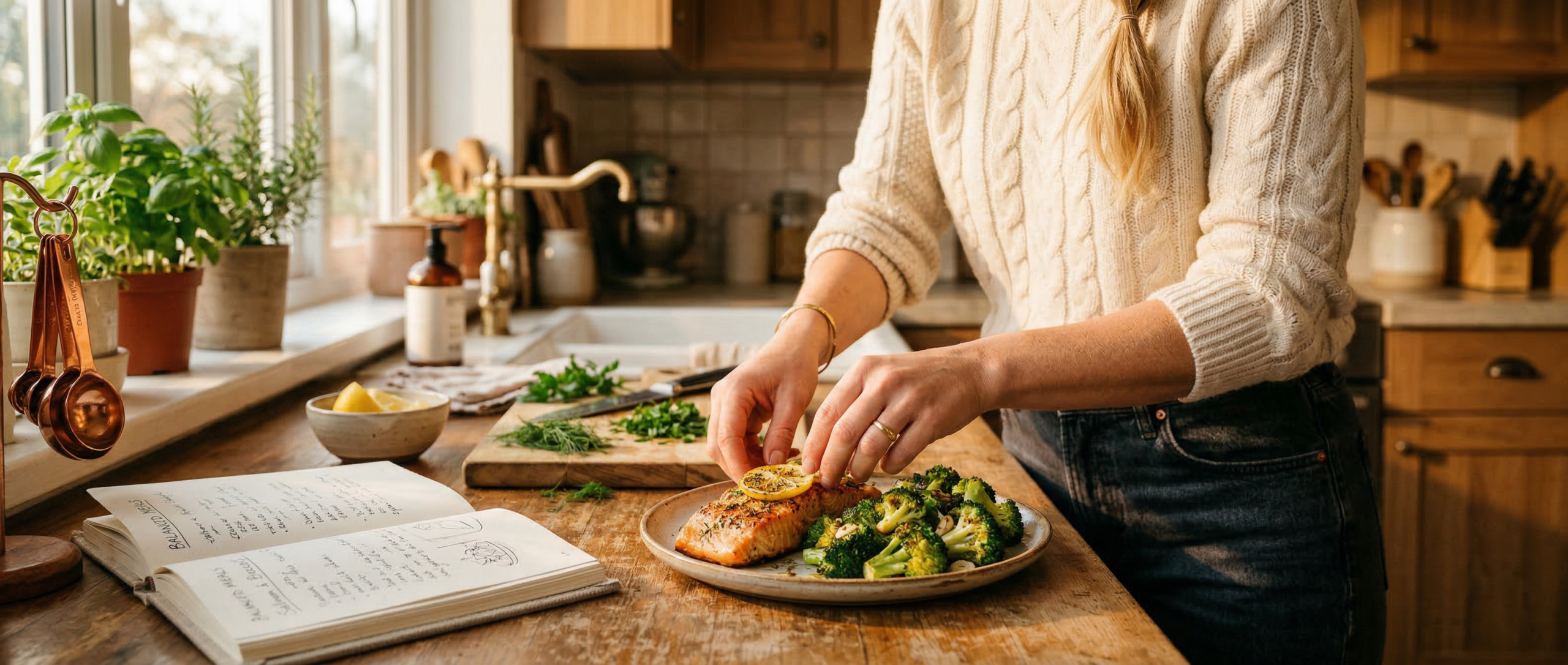
When you cook, you decide the ratio. You decide that the base of the bowl is fish or chicken or lentils or eggs, not noodles. You decide that the sauce builds on protein rather than just fat and sugar. You make the call that outsourced food cannot make for you, because outsourced food does not know what your body needs right now.
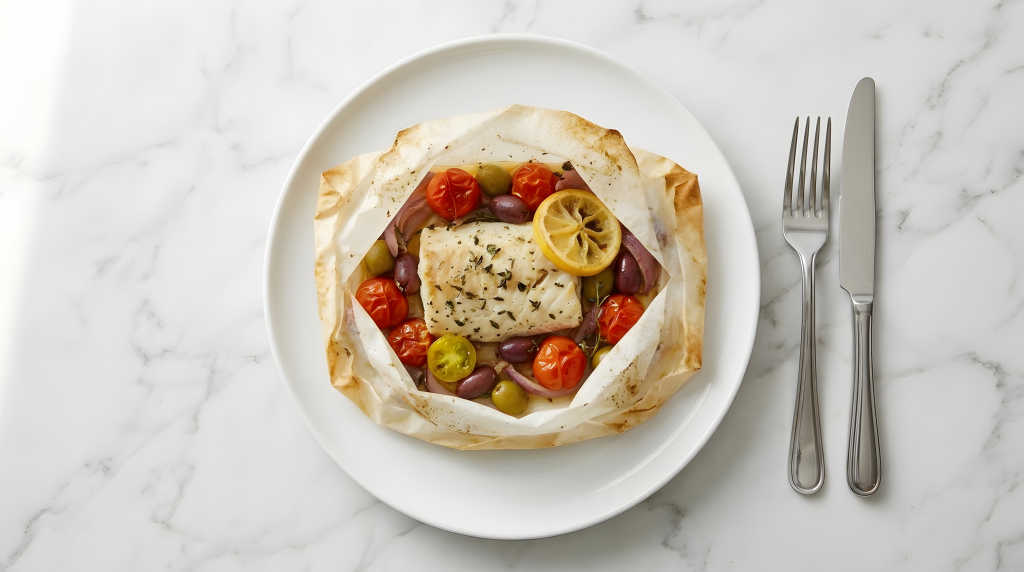
Take Mediterranean Cod en Papillote: cooked in parchment so the kitchen stays nearly scent-free, 35 grams of protein, straightforward enough for a weeknight. Or the Chive Custard Breakfast Bake: eggs and cottage cheese delivering sustained protein from the first meal of the day, before the decisions get harder. Neither feels like compliance food. Both are doing exactly the right work.
You do not need to track every gram. You do not need a spreadsheet or an app. You need to understand the principle and build a small repertoire, ten or fifteen meals, that deliver it. Meals you actually look forward to. Meals that do not feel like medical compliance, that could sit on the table in a decent restaurant and hold their own against anything else on the menu.
That last part is not a luxury. Biology seeks pleasure from food, and that is not a weakness to manage but a feature to work with. If the meals are joyless, you will not cook them. You will find workarounds. You will revert, not because willpower failed, but because nobody sustains something that feels like punishment. The food has to be genuinely good. Not diet-food good. Actually good.
A recipe engineered purely around macros is a chore. A recipe that hits the right numbers because it was built by someone who cares how food tastes is something you make again.
Cod en papilotte (in paper)
The Path Forward
Your determination and will matters, but it has to be applied where it matters.
If you try to fight your way through your weight loss as if it was a war, where good food is the enemy, odds are you will end up on the casualty list. When the viewpoint shifts from what you must deny yourself to choosing between foods you like, your kitchen stops being a battlefield.
In the end, food isn’t complicated. Neither is making it. And no one is watching over your shoulder to check your plating skills or if you eat it straight out of the pan.